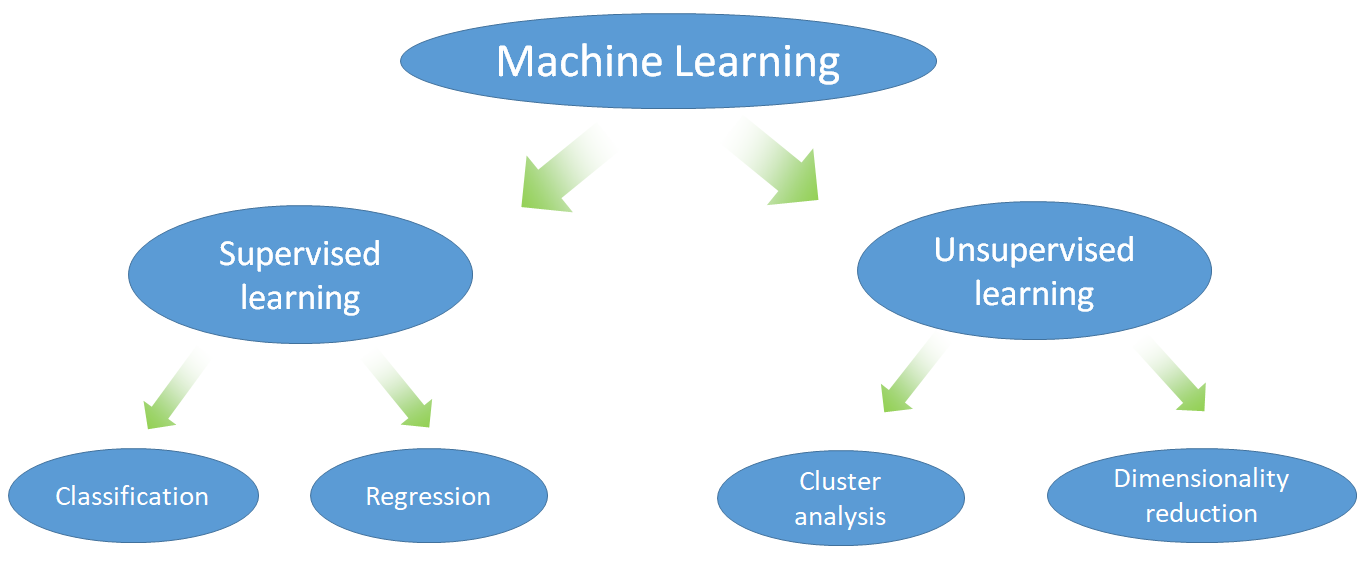
SUPERVISED LEARNING involves training an algorithm to map labelled training input data to desired output data. Approaches can use regression or classification algorithms based on numerical and categorical desired outputs respectively. Comparing its output against the desired output, allows adjustments to be made to reduce errors between the two. Using training data examples, the model should learn to produce desired outputs, when exposed to unlabelled input data. For example, figure 1 shows the model predicting unlabelled images of sharks as fish, based on the learning algorithm mapping labelled training data of sharks to a fish output (Chapman, 2018; GeekforGeeks, n/d; Tagliaferri, 2017).
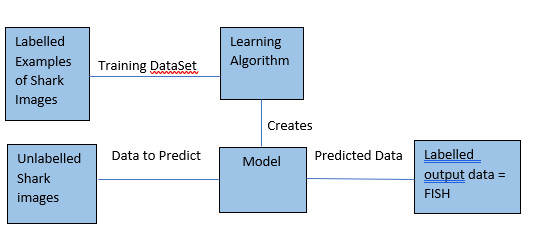
Figure 1 adapted from Berral et al (2010), showing supervised learning for shark images.
Supervised machine learning has useful applications including within the stock market where historical data can be useful in predicting market trends (Tagliaferri, 2017).
UNSUPERVISED LEARNING involves unlabelled data and an unsupervised learning algorithm exploring and organising complex data using cluster analysis or reduction of dimensionality in large data sets, without the direction of a correct known output (Calvo, 2015; Chapman, 2018; Tagliaferri, 2017).
Unsupervised machine learning can give meaning to data, uncover hidden patterns and look for any anomalies, leading to practical applications including in fraud prevention and marketing. For example, analysing transactional data can provide information about customer buying habits, including the type of people that purchase certain products. Those relationships can then be used to direct and increase the success of marketing campaigns (Chapman, 2018; Tagliaferri, 2017).
Words 250
References:
Berral, J. L, Goiri, I., Nou, R., Ferran, J., Guitart, J., Gavaldà, R. and Torres, J. (2010) ‘Towards energy-aware scheduling in data centers using machine learning’ [Online]. Available at: https://www.researchgate.net/figure/Supervised-Machine-Learning-Schema_fig1_221561415 (Accessed 27 May 2019).
Calvo, D. (2015) ‘Definition of Machine Learning’ [Figure]. Available at: http://www.diegocalvo.es/en/machine-learning-supervised-unsupervised/ (Accessed 27 May 2019).
Chapman, D (2018) ‘Surveillance and Artificial Intelligence‘ Communication and information technologies, Protecting and Prying Oxford, Oxford University Press/Milton Keynes, The Open University, p.p. 129-131.
GeekforGeeks (n/d) ‘What is Regression and Classification in Machine Learning?’ [Online]. Available at: https://www.google.ie/amp/s/www.geeksforgeeks.org/regression-classification-supervised-machine-learning/amp/ (Accessed 27 May 2019).
Tagliaferri, L. (2017) ‘An Introduction to Machine Learning’, DigitalOcean Community Tutorials, 28 September [Online]. Available at https://www.digitalocean.com/ community/tutorials/ an-introduction-to-machine-learning (Accessed 26 May 2019).
 machinelearning.movie.blog